n8n Lead Generation Automation: Build a Pipeline That Runs Itself
Most lead generation bottlenecks aren't a lack of prospects — they're the hours spent manually finding, checking, and logging them before a sales rep ever sends a message. An n8n lead generation pipeline automates that entire front half of the funnel, so reps open their day with a list of qualified, enriched leads instead of a research task.
For the broader picture of what n8n automates across a business, see our complete guide to n8n workflows.
What a lead generation pipeline actually automates
A full pipeline has three distinct jobs, and treating them as three separate workflows — rather than one giant script — makes each one easier to debug and swap out later:
- Sourcing — pulling candidate leads from a source: a LinkedIn search, a form fill, an inbound signup, a scraped directory.
- Enrichment and scoring — filling in missing data (company size, industry, role) and scoring fit against your ideal customer profile.
- Routing — landing qualified leads in your CRM, notifying the right rep, and disqualifying or nurturing the rest.
Step 1: Automate lead sourcing
The trigger depends on where your leads actually come from. A Schedule Trigger running a LinkedIn Sales Navigator search on a cron interval works for outbound prospecting; a Webhook Trigger connected to your website's form fits inbound. Either way, the output of this step should be a consistent, structured record — name, company, role, contact info — even if the sources are different shapes going in. Use a Set node immediately after sourcing to normalize every lead into the same schema before it moves further down the pipeline.
Step 2: Enrich before you score
Raw contact information rarely has enough signal to score fit accurately. An enrichment step — calling a data provider's API or an AI model — fills the gaps: company size, funding stage, tech stack, seniority. This is also where an HTTP Request node to a service like Clearbit, Apollo, or a similar enrichment API earns its place in the workflow, since scoring on incomplete data produces false positives and false negatives at roughly the same rate.
Step 3: Score leads against your ICP
Scoring is the step most teams either skip or hardcode with brittle if/else logic. A more durable approach: define your ideal customer profile as a set of weighted criteria (company size, industry match, role seniority, engagement signal) and use an IF or Switch node to route leads into tiers — hot, warm, cold — based on the total score. For nuanced qualification that's hard to express as fixed rules, an AI node evaluating the lead against a written ICP description in plain language often outperforms a rigid point system, especially for B2B leads where fit isn't purely demographic. Once scored, n8n CRM automation covers writing that record into your CRM cleanly and keeping it in sync.
Step 4: Route qualified leads to sales
A lead that scores as "hot" should reach a rep within minutes, not sit in a CRM view nobody checks. Route hot leads to a Slack or email notification with the enriched context attached, and push every lead — regardless of tier — into your CRM so the full history is queryable later. Warm and cold leads can flow into a separate nurture sequence instead of a rep's inbox, which keeps sales focused on the leads actually worth a phone call.
Step 5: Layer in outreach
Once qualified leads are landing in your CRM automatically, the natural next step is automating the first outreach message too — a personalized email or LinkedIn message generated from the same enrichment data you already collected, rather than a generic template. Cold outreach automation with n8n and AI covers this step in detail.
Common mistakes that break lead gen pipelines
The pipelines that fail in production usually fail for the same handful of reasons: no deduplication (the same lead gets sourced twice and double-messaged), no rate limiting against the enrichment API (leading to a mid-run failure that silently drops the rest of the batch), and no fallback when an external API is down. These aren't lead-gen-specific problems — they're the same failure patterns covered in 7 n8n workflow mistakes that break your automations.
Build it faster with a tested pack
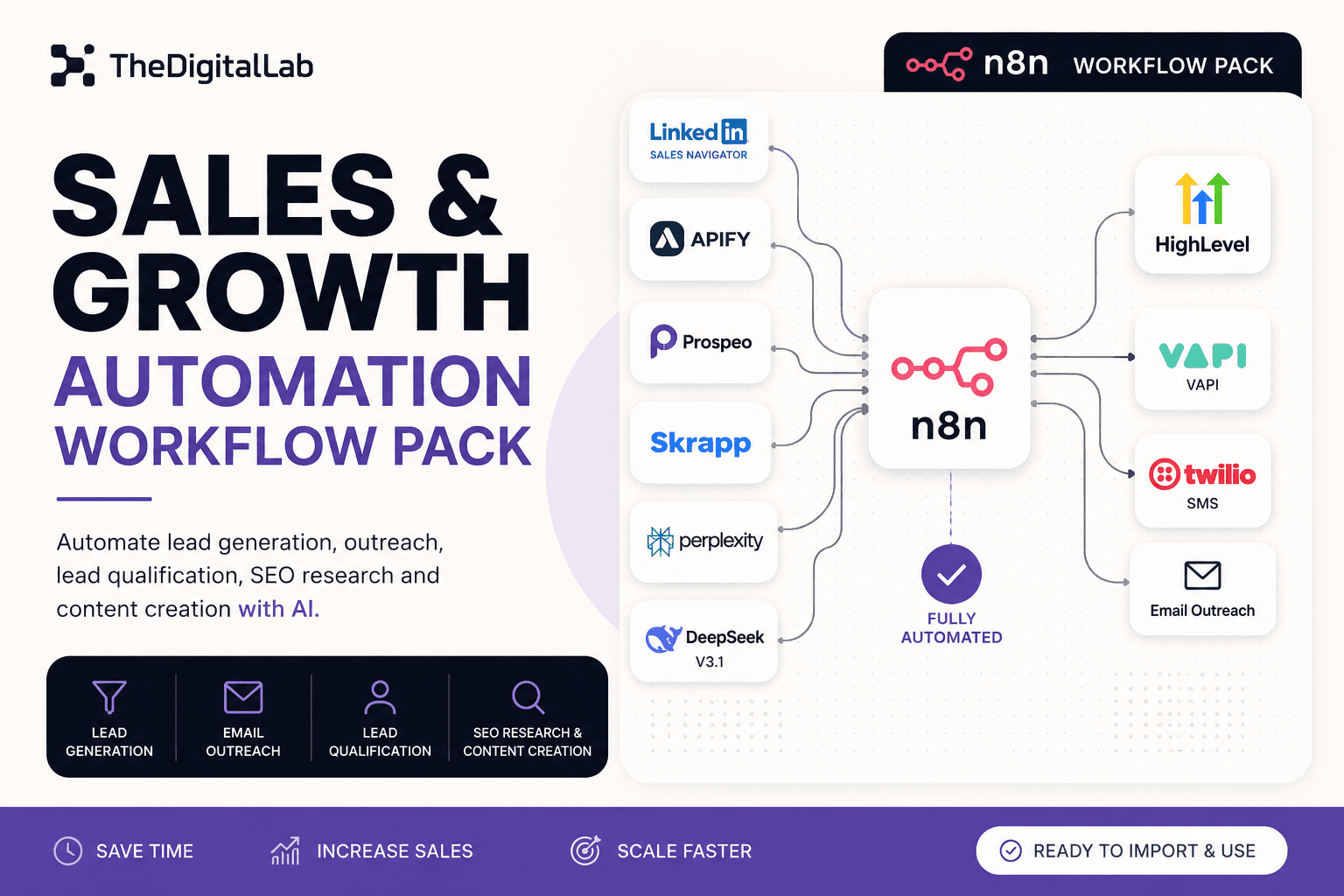
Wiring sourcing, enrichment, scoring, and routing together correctly takes longer than any single step suggests — mostly because the failure modes only show up once real, messy data runs through the pipeline. Our Sales & Growth Automation Workflow Pack ships LinkedIn prospecting, AI-powered lead qualification, and outreach as three tested workflows built to work together, so you're adjusting scoring criteria and message templates instead of debugging the plumbing between them.
Build this with
More from the lab
View all posts →n8n Workflows: The Complete Guide to Automating Your Business
What n8n workflows actually are, when to build vs. import one, and how to use them to automate social media, lead generation, e-commerce and more.
n8n Workflow Templates: Where to Find Free, Ready-to-Use Automations
Where to find free n8n workflow templates, how to evaluate one before importing it, and when a paid workflow pack saves more time than a free template.
7 n8n Workflow Mistakes That Break Your Automations (and How to Fix Them)
The most common n8n workflow mistakes — from missing error handling to hardcoded credentials — and the specific fix for each one.